


Men's health exam Best Practices and Expert Advice
What if the most useful part of a men's health exam is having time to talk? The visit isn’t a preset bundle of tests. It should start with your health, concerns, and questions, then help you and your clinician decide what makes sense for you.
It’s understandable to feel unsure about what to expect or hesitant to bring up sexual health and other personal topics. Preparing a few notes can make the conversation more comfortable and useful. This guide explains how to get ready, what may come up during the exam, and how your health history and individual needs can guide decisions about tests.
For men in Plymouth, Fareed Clinic provides men's health care, physical exams, and Labcorp testing, with follow-up care when needed. The goal is to make it easier to discuss your concerns and connect preventive care with your ongoing health.
Table of Contents
What Is a Men’s Health Exam, and What Is It For?
A men's health exam is a visit with a clinician to discuss your overall health, personal concerns, and preventive care that may be appropriate for you. The conversation may cover your medical and family history, current symptoms, medications, and health goals, along with a physical assessment when needed. A physical examination may involve checking parts of the body to assess health, but what happens during your visit depends on your situation.
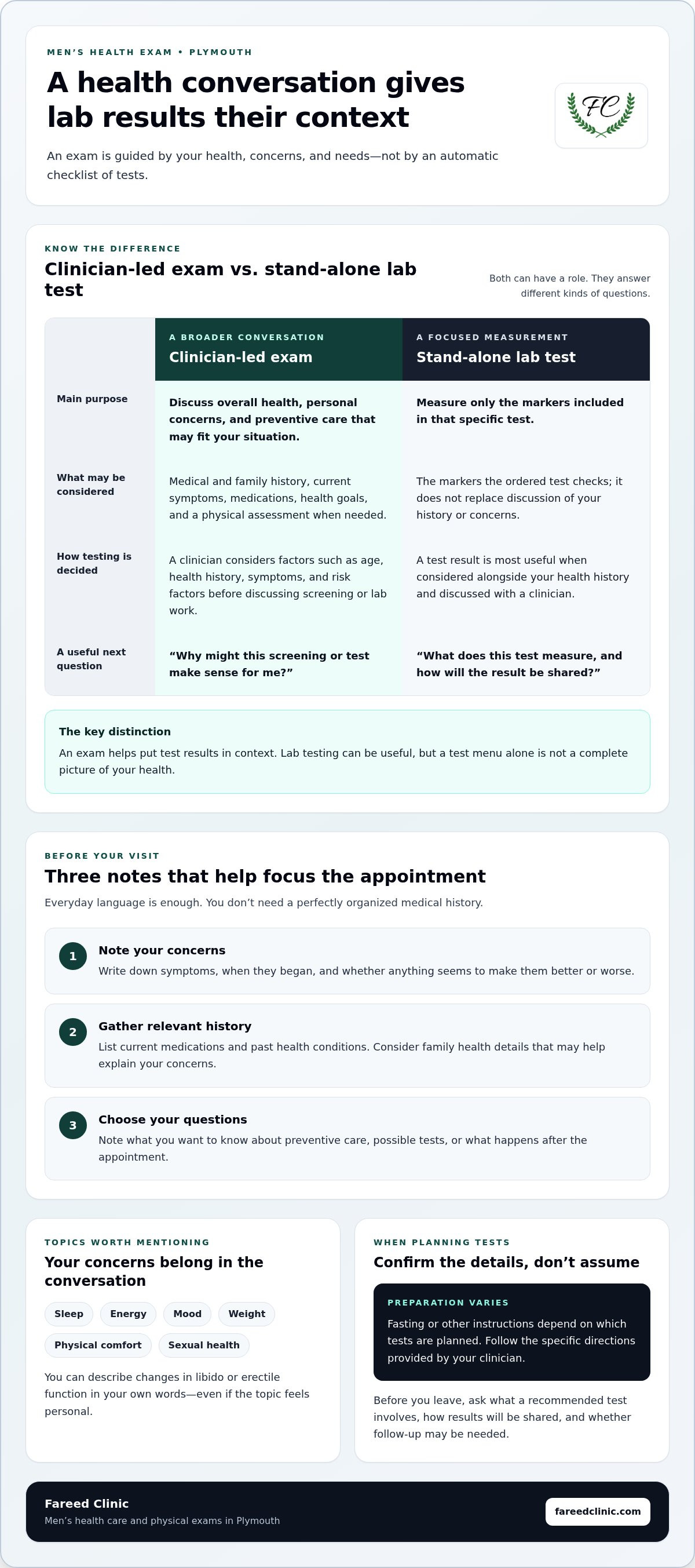
There’s no automatic checklist of tests for every man. A clinician considers factors such as your age, health history, symptoms, and risk factors before discussing whether screening or lab work may be useful. Bring up specific concerns and ask why a test is being considered. This keeps the conversation focused on your needs rather than treating a test menu as a complete picture of your health.
A clinician-led exam puts test results in context; a stand-alone lab test measures only the markers it checks. Lab testing can be useful, but it doesn’t replace a conversation about your health history or concerns.
Why an exam can matter even when you feel well
Feeling well is reassuring, but it can’t answer every health question. Some conditions, including high blood pressure and certain cancers, may develop without noticeable symptoms. The U.S. Preventive Services Task Force bases screening recommendations on factors such as age and individual risk, rather than recommending every test for everyone. A clinician can review your history and discuss which preventive steps may fit, without promising that an exam will prevent illness or detect every condition.
Your concerns belong in the conversation, too. Changes in energy, sexual function, mood, sleep, or weight can be worth mentioning, even if they feel awkward or seem unrelated. Sharing what you’ve noticed gives the clinician more context to consider possible next steps with you.
How to Prepare for a Men’s Health Exam and Make the Visit Useful
A little preparation can help you use your appointment well. Before your men's health exam, jot down what you’ve noticed and what you’d like to understand. You don’t need medical terms or a perfectly organized history. A short, clear note in everyday language is enough to start the conversation.
Note your concerns. Write down symptoms, when they began, and whether anything seems to make them better or worse.
Gather relevant history. List current medications and past health conditions. Consider family health details that may help explain your concerns.
Choose your questions. Note what you want to know about preventive care, possible tests, or what happens after the appointment.
What should you bring up during the appointment?
Share symptoms and changes that affect daily life, such as sleep, energy, mood, or physical comfort. Sexual health is also a valid part of your overall health. You can mention changes in libido or erectile function in your own words, even if the topic feels personal. A clinician can help clarify what may be relevant and discuss possible next steps without judgment.
If you’re unsure how to begin, try: “I’ve noticed a change and would like to talk about it.” Before you leave, ask what any recommended test involves, how results will be shared, and whether follow-up may be needed. These questions can help make the next step clearer.
Preparation for testing varies. Fasting or other instructions depend on which tests are planned, so follow the specific directions provided by your clinician rather than assuming every visit requires fasting. In Plymouth, Fareed Clinic’s men’s health care offers a local place to discuss concerns and plan appropriate follow-up.
Men’s Health Care in Plymouth: Finding a Clear Next Step
If you’re ready to move from questions to a care plan, Fareed Clinic in Plymouth provides men's health care and physical exams. A visit gives you a place to discuss your concerns with a clinician and consider what follow-up, if any, may be useful. You can book an appointment online.
How Fareed Clinic can support your next step
Care options include physical exams, telehealth visits, and chronic care management. These services can support a conversation about immediate concerns and health needs that benefit from ongoing attention. Insurance and self-pay options are available for services.
Lab testing may also be part of care when appropriate. Labcorp testing is available to everyone, including people who aren’t Fareed Clinic patients. You don’t need to be a clinic patient to access testing. Test results are most useful when considered alongside your health history and discussed with a clinician.
As you plan a men's health exam, keep your notes and questions nearby so you can share what matters most to you. Fareed Clinic serves patients in Plymouth and nearby communities, including Maple Grove, Medina, Wayzata, Minnetonka, Brooklyn Park, Edina, Bloomington, Champlin, New Hope, Golden Valley, and St Louis Park. You don’t need to have every concern figured out before starting a conversation.
Make Your Health a Continuing Conversation
Your health needs can change over time, so think of a men's health exam as one step in an ongoing conversation, not a test you have to pass. Start with the concern that matters most today. If a next step is recommended, ask why it may help and how follow-up works so you can stay involved in your care.
There’s no need to wait until you have every question perfectly phrased. A simple, honest conversation can be a useful place to begin, and you can raise concerns at a pace that feels comfortable.
Ready to take that step? Schedule an appointment with Fareed Clinic to start the conversation.
Frequently Asked Questions
Do I need a men’s health exam if I feel healthy?
Feeling well doesn’t rule out a useful visit. A men’s health exam gives you a chance to discuss personal or family health changes and ask whether preventive care fits your circumstances. If you have a new symptom, a medication concern, or a family health issue on your mind, bring it up rather than waiting for it to affect daily life.
Should I fast before a men’s health exam?
Not necessarily. Fasting depends on whether specific tests are planned and on the instructions for those tests. Don’t assume you need to skip a meal for every exam. Follow the preparation directions from your clinician. If you’re unsure what to do, clarify the instructions before your appointment so you can prepare appropriately.
Can I discuss erectile dysfunction or low libido during a men’s health exam?
Yes. Erectile dysfunction and low libido are valid health concerns, and Fareed Clinic provides care related to both. Describe what has changed, when you first noticed it, and how it affects you. You don’t need to know the cause or use clinical terms to start the conversation. Sharing your concern helps guide a discussion about possible next steps.
Can I get Labcorp testing at Fareed Clinic without becoming a patient?
Yes. Labcorp testing is available to people who aren’t Fareed Clinic patients, so you don’t need to become a clinic patient to access testing. Fareed Clinic is located in Plymouth and serves people in nearby communities, including Maple Grove, Medina, Wayzata, Minnetonka, Brooklyn Park, Edina, Bloomington, Champlin, New Hope, Golden Valley, and St Louis Park.


Comments