


5 Steps to Find Affordable Primary Care in Your Area
Last Updated: October 25, 2026
Quick Summary
Finding affordable primary care starts by understanding your insurance coverage, deductible, copay, and coinsurance, then using your insurer's provider directory to locate in-network doctors and verify network status by phone before booking. For uninsured patients, compare self-pay costs across community health centers, direct primary care practices, and traditional practices using a cost worksheet that captures visit fees, lab prices, and follow-up policies.
Check your insurance deductible, copay, and coinsurance percentage before searching for a provider to know your actual out-of-pocket costs.
Verify in-network status by calling both the clinic and your insurer's member services line to avoid surprise out-of-network bills.
Use the HRSA Find a Health Center tool to locate federally funded community health centers that offer sliding fee scales based on income.
Compare total episode cost across providers, not just the visit fee, by including new-patient visit, routine labs, and follow-up visit in your calculation.
Ask prospective providers about board certification, time spent with new patients, telehealth availability, and continuity of care before booking.
Table of Contents
Step 1: Understand Your Coverage and Out-of-Pocket Options
Step 2: How to Find a Primary Care Doctor in Your Network
Step 2a: Pull your plan's cost-sharing details first
Step 2b: Use the insurer's provider search, correctly
Step 2c: Verify network status by phone
Step 2d: Estimate your out-of-pocket cost before booking
Step 2e: Questions to ask the office before booking
Step 3: Compare Primary Care Without Insurance and Self-Pay Options
Build a one-page cost worksheet
Provider types to include in the comparison
Questions to ask on every call
Compare total episode cost, not just the visit fee
Step 4: Questions to Ask a Doctor Before Booking Your Visit
Step 5: Explore Sliding Scale Clinics Near You
Preventive Care: A Cost-Effective Strategy for Affordable Primary Care
Schedule Your First Affordable Primary Care Visit
Frequently Asked Questions
Step 1: Understand Your Coverage and Out-of-Pocket Options
Finding affordable primary care starts with understanding your finances, since your coverage situation determines which options are realistic. (Source: U.S. Department of Health and Human Services Office of Disease Prevention and Health Promotion)
Check your insurance status: employer-sponsored, marketplace, or none. Learn more about insurance options and partnerships available to help you understand your coverage.

Here's what each one means:
Deductible: The amount you pay before insurance kicks in
Copay: A fixed fee per visit (often $20-$50)
Coinsurance: Your percentage of costs after the deductible is met
If you're uninsured, you have options too. According to the U.S. Department of Health and Human Services Office of Disease Prevention and Health Promotion, lack of health insurance decreases use of preventive and primary care services.
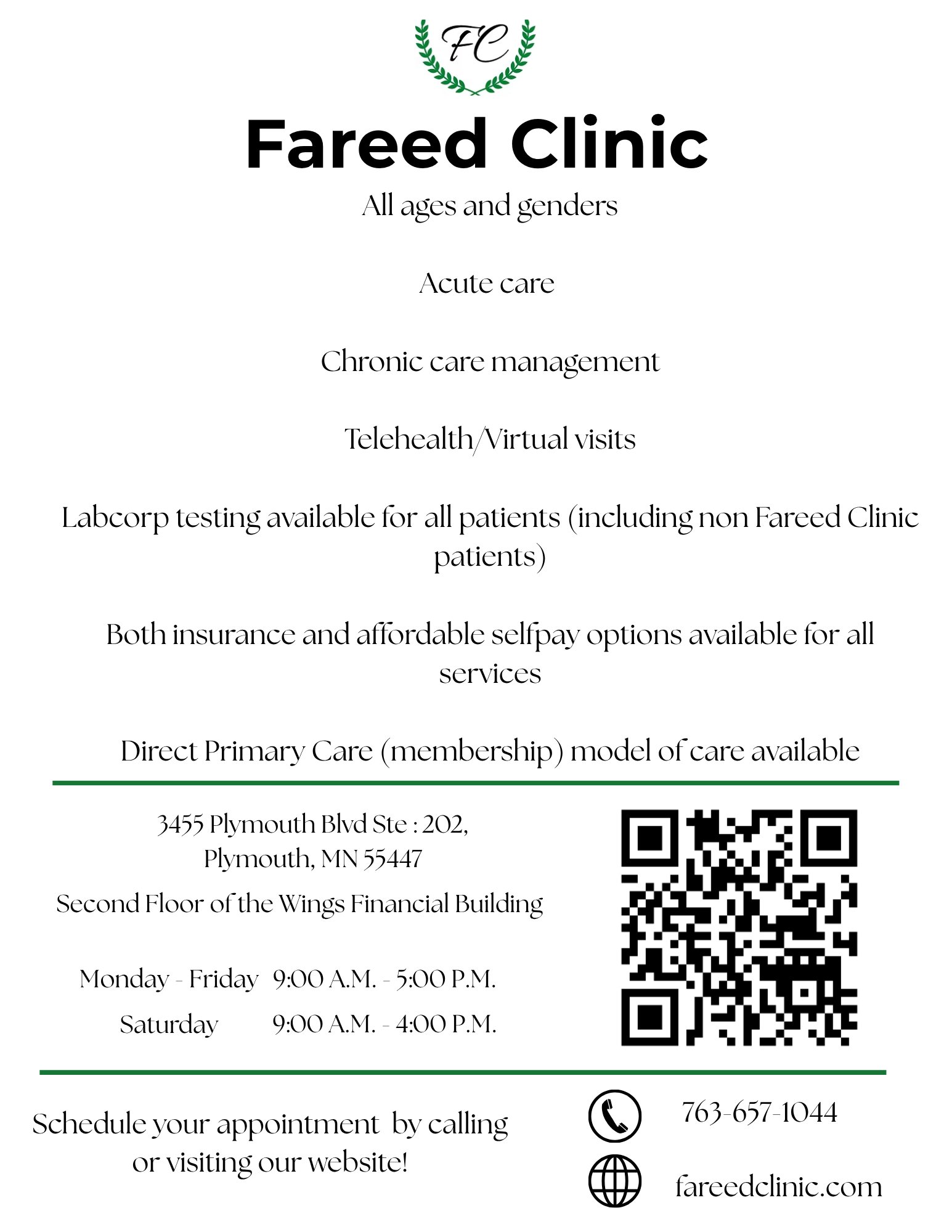
At Fareed Clinic, we work with patients across all coverage situations.
Step 2: How to Find a Primary Care Doctor in Your Network
If you have insurance, staying in-network is the biggest lever on your out-of-pocket cost. Out-of-network visits can cost substantially more, and the difference isn't always obvious from a provider's website. These steps turn the insurer's directory into a verified, cost-checked shortlist.
Step 2a: Pull your plan's cost-sharing details first
Before searching for a doctor, log into your insurer's member portal and note four numbers:
Deductible, the amount you pay before the plan begins sharing costs.
Coinsurance, your percentage of costs after the deductible is met (for example, 20%).
Copay, the fixed amount for a primary care visit, if your plan uses copays instead of coinsurance.
These four numbers tell you what an in-network visit will actually cost. A $0 copay plan and a high-deductible plan can both be in-network, but the out-of-pocket experience differs greatly.
Step 2b: Use the insurer's provider search, correctly
Open your insurer's provider directory and search for "primary care" or "family medicine" in your area. Apply these filters in order:
Network status, confirm the provider is listed as in-network for your specific plan, not just the insurer overall. Many insurers offer multiple networks under one brand.
Accepting new patients, filter for this; a provider who is not accepting new patients is not a real option regardless of network status.
Provider type, family medicine, internal medicine, or pediatrics, depending on who needs care.
Location and telehealth, filter for a location you can reach and for telehealth if that matters to you.
Step 2c: Verify network status by phone
Provider directories are often out of date. Before booking, call the clinic and ask:
"Are you in-network with [your plan name and network name]?"
"Are you accepting new patients on that plan right now?"
Then call your insurer's member services line to confirm the same provider is in-network for your plan. If they disagree, trust the insurer and get the call reference number. This two-call check is the most reliable way to avoid a surprise out-of-network bill.
Step 2d: Estimate your out-of-pocket cost before booking
Once you have an in-network provider, ask the billing office for a good-faith estimate of what your visit will cost after insurance. Under the No Surprises Act, uninsured and self-pay patients are entitled to one for scheduled services, and many clinics provide one for insured patients too. Ask specifically:
What will I owe at the time of service (copay or coinsurance)?
Will labs ordered at the visit be billed separately, and are they in-network?
Is there a separate facility fee, or is the visit billed as a single professional claim?
Write the answers down next to the provider's name on your shortlist.
Step 2e: Questions to ask the office before booking
Once network and cost are confirmed, ask these questions to judge fit:
Are you accepting new patients, and how long is the wait for a new-patient appointment?
How long is a typical new-patient visit?
Do you offer telehealth, and is it billed the same as an in-person visit?
If you can't find an in-network provider with reasonable availability, call member services for a list of in-network primary care providers accepting new patients. Insurers must maintain accurate directories, and member services often surfaces options the public search tool hides.
At Fareed Clinic, we serve patients across the Minneapolis-St. Paul area, including Plymouth, Maple Grove, Minnetonka, Medina, Wayzata, Eden Prairie, New Hope, Champlin, Brooklyn Park, Brooklyn Center, Golden Valley, Lakeville, Apple Valley, Rosemount, Coon Rapids, Buffalo, Corcoran, Watertown, Crystal, Robinsdale, Hopkins, Edina, St Louis Park, Richfield, Bloomington, Hamel, Long Lake, Maple Plain, Blaine, Fridley, Savage, Shakopee, Chaska, Eagan, Blaine, Roseville, St Paul, Maplewood.
Step 3: Compare Primary Care Without Insurance and Self-Pay Options
For uninsured and self-pay patients, comparing costs is essential because prices vary widely between providers and visit types. Most online listings show only a single headline number, if any, so the reliable way to compare is a simple cost worksheet filled in for each provider.
Build a one-page cost worksheet
For every provider you call, capture the same five line items so the comparison is apples-to-apples:
New-patient visit fee, the self-pay price for an initial office visit, not just a follow-up.
Established-patient visit fee, what a routine follow-up costs once you're a patient.
What's included in the visit, history, exam, basic in-office tests (strep, flu, urinalysis), and any patient education.
Common lab prices, ask specifically for a complete blood count (CBC), a comprehensive metabolic panel (CMP), a lipid panel, and an A1c. These four cover most routine primary care screening.
Follow-up and after-hours policy, whether a follow-up visit to review labs is billed separately, and how phone or portal questions are handled.
Add a sixth column for payment terms: whether the clinic offers a payment plan, requires payment at time of service, or bills afterward. Billing after the visit isn't necessarily cheaper, but it changes your cash-flow planning.
Provider types to include in the comparison
Community health centers: Federally funded and required to offer a sliding fee discount program based on income and family size. Use the HRSA Find a Health Center tool to locate them by ZIP code, then ask specifically about the sliding fee scale and what income documentation is required.
Direct primary care (DPC) practices: Charge a recurring membership fee (often monthly) that typically covers office visits, some in-office labs, and direct access to your clinician. The trade-off is that the membership fee is separate from insurance, and you should ask what is not included (specialist referrals, imaging, outside labs).
Urgent care clinics: Appropriate for a single acute problem, but not a substitute for ongoing primary care. Ask for the self-pay price of a standard visit and whether a follow-up is included.
Questions to ask on every call
Use the same script for each provider so answers are comparable:
"What is your self-pay price for a new-patient visit, and what does that visit include?"
"If the clinician orders a CBC, CMP, lipid panel, or A1c, are those billed separately? What is the self-pay price for each?"
"Is a follow-up visit to review results included, or is it a separate charge?"
Ask for the estimate in writing, email or a printed summary, so you have a record if the final bill differs. (Source: Centers for Medicare & Medicaid Services (CMS) website)
Compare total episode cost, not just the visit fee
A single visit fee tells you little. Compare the total cost of a typical episode: one new-patient visit, likely routine labs, and one follow-up.
At Fareed Clinic, we quote a flat self-pay rate for the visit and tell you upfront which in-office services are included, so the worksheet above has fewer blanks to fill in.
Use this worksheet to compare self-pay primary care costs across different provider types.
Provider Type | Best For | Key Difference |
Community health centers | Uninsured patients | Sliding fee scale based on income |
Direct primary care (DPC) | Ongoing access | Monthly membership covers visits and some labs |
Urgent care clinics | Single acute problems | Not designed for chronic-condition management |
Retail clinics | Quick, transparent pricing | Limited scope, not for preventive care |
Traditional practices | Established patients | Flat self-pay rate with upfront pricing |
Step 4: Questions to Ask a Doctor Before Booking Your Visit
Before you book, ask questions that reveal whether this provider is right for you and help you avoid wasting time or money on a poor fit.
Ask about the provider's experience and credentials:
Are you board-certified in family medicine or internal medicine?
How long have you been practicing primary care?
Do you have experience managing my specific health conditions?
Ask about the visit itself:
How much time do you typically spend with new patients?
Can I reach you between visits if I have questions?
Do you offer telehealth visits?
Ask about continuity of care:
Will I see the same doctor for follow-up visits?
How do you handle prescription refills?
Do you coordinate care with specialists if I need referrals?
These questions matter because primary care is about building a relationship with one provider over time. A doctor who rushes visits or isn't available for follow-up won't serve you well, even at a low price.
Step 5: Explore Sliding Scale Clinics Near You
Sliding scale clinics adjust fees based on income and family size.
To find one, start with the federal health center locator.
When you call, ask:
What income levels qualify for sliding scale fees?
What documents do I need to bring to prove my income?
Do I need an appointment for the intake process, or can I apply before my first visit?
Bring recent pay stubs, tax returns, or an employer letter showing your income; the clinic uses this to calculate your fee.
The trade-off with sliding scale clinics is that wait times can be longer because they serve high-volume populations.
Preventive Care: A Cost-Effective Strategy for Affordable Primary Care
Preventive care is one of the smartest ways to reduce your overall healthcare costs.
According to HealthCare.gov, most health plans must cover a set of preventive services, including shots and screening tests, at no cost to the patient.
If you're uninsured, preventive care is still worth prioritizing. A blood pressure check or cholesterol screening costs far less than treating a heart attack.
Talk to your primary care provider about which preventive services you need based on your age and health history. Common preventive services include:
Annual physical exam
Blood pressure screening
Cholesterol screening
Building a relationship with one primary care provider makes preventive care easier.
Schedule Your First Affordable Primary Care Visit
You've done the research, compared options, and found a provider.
Call the office during business hours or use their online booking system if available.
Prepare for your visit by writing down your health history and current medications.
During your first visit, be honest about your health concerns and your financial situation.
Finding affordable primary care takes effort, but it's worth it.
Frequently Asked Questions
How much is a primary care check-up without insurance?
Costs vary significantly depending on the provider and services needed. Fareed Clinic offers transparent, flat-rate self-pay pricing of $149.99 for a primary care visit, with no hidden charges. Community health centers funded by HRSA may offer free or reduced-cost visits based on income. Contact providers directly to compare costs before booking, and ask what the fee includes, lab work, imaging, or medications may be separate.
What should I ask a clinic before booking a self-pay visit?
Ask about the total flat fee and what services it covers, whether lab tests or imaging cost extra, if the provider is board-certified, how long you can expect to wait, and whether they offer payment plans or financial assistance. Confirm the clinic's experience with your specific health concern and ask about the provider's approach to preventive care and chronic disease management. Request an estimate in writing before your visit.
Can I use a community health center for primary care?
Yes. The Health Resources and Services Administration (HRSA) funds approximately 1,400 community health centers nationwide that provide primary care services, including for uninsured patients. Many offer sliding-scale fees based on income. You can search for a center near you using HRSA's Find a Health Center tool by entering your city, state, or ZIP code. These centers provide comprehensive primary care, preventive services, and often accept multiple insurance plans.
How do I verify if a doctor is board-certified in family medicine?
Check the American Board of Family Medicine (ABFM) verification tool on their website, or ask the clinic directly for proof of certification. Board-certified physicians have completed specialized training and passed rigorous exams in their specialty. Dr. Mohammad Tariq Fareed is a Diplomate of the American Board of Family Medicine with 20+ years of experience and former Assistant Professor of Family Medicine at Mayo Medical School, ensuring evidence-based, quality care.
Affordable primary care starts with knowing your options and taking action. We're here to help you every step of the way. At Fareed Clinic, we serve patients across the entire Minneapolis-St Paul area with transparent pricing, board-certified care, and a commitment to your health. Our flat-rate model eliminates billing surprises, and our experienced team manages everything from minor illnesses to chronic disease management. Schedule your first visit today and take control of your healthcare.
Book Online
Add fareedclinic.com as a preferred source on Google →


Comments